
Yes, I am late for this journal entry. I was super pre-occupied with GWD26 during the first week of September, where I usually document what was consumed the month before. But I have just returned home from the show plus a side vacation to Burgundy and Champagne, watch for those reports next month, and now am able to just sit down and document the August champagnes and wine.
More of the best champagnes we experienced in August
August was a great month for my drinking journal. Not only did I get to taste some great champagnes and interesting still wines. But it was with many great friends, which always make the experience all the better. So here we go!
I start with a dinner with a friend ath 67 Pall Mall, with a flavour of his favourite wines.
Étienne Calsac L’Echappée Belle
We begin with a champagne which I selected. The only one from this dinner chosen by me. I have discussed Étienne Calsac in the context of his unusual Les Revenants which featured 6 of the 9 grapes allowed by the Comité Champagne, and avoiding all 3 of the most used. So no Chardonnay, no Pinot Noir, no Meunier. It was a very interesting champagne. And for this round, I selected another of this celebrated grower-producer from Avize. And the L’Echappée Belle, meaning “The Beautiful Escape” in French, being the reference to his bold move in 2010 when he claimed his family’s vineyards to produce champagne himself instead of selling to the big houses. His focus in winemaking is always to make pure, terroir-driven, expressive Champagnes. Viticulture is organic and biodynamic. And each parcel is vinified separately. This champagne comprise solely of Chardonnay.

The wine is made 100% Chardonnay from the Premier Cru village of Grauves known for cooler microclimate and sharp acidity and cleverly balanced with plots in Montgenost (Côte de Sézanne) and Bisseuil (Vallée de la Marne). The cepage also draws from a perpetual reserve. Approximately 25% is from the solara he established from the first harvest in 2011. Vinification is by indigneous yeast, with 75% in steel vats, and the rest aged in oak. Dosage is only 3g/L, thus Extra-Brut. And the disgorgement was April 2025.

The usual pale lemon is particularly brilliant in hue. On the nose, it follows as vibrant with aromas of green apple, lemon zest. As it warms in the glass, it develops with notes of brioche and almond, probably from the reserve wines. On the palate, it is superbly tense showing up as crisp grapefruit and saline. This is not as aggressive as it may sound, as the oak offers some malolactic signatures bringing a creamy texture beneath the sharpness of the acid. Finish is clean and dry, and is very long.
And the name – L’Echappée Belle, the Beautiful Escape is the perfect. For a Friday evening out with friends, as we escape into the weekend.
Chateau Haut Brion 2001 Pessac-Léognan
We then move to the wine my friend chose. This is the exceptional Bordeaux from Haut Brion. The Château is from the Pessac-Léognan appelation in Bordeaux and is an extraordinary, classic expression of this legendary First Growth. The 2000 vintage was phenomenal and the 2001 spent many years under its shadow. But the wine has now matured very nicely into a textbook connoisseur vintage.

Haut Brion is usually Cabernet heavy, as is the norm for left bank wines, but the 2001 Grand Vin is a departure. This vintage is composed of 52% Merlot, 26% Cabernet Sauvignon and the rest Cabernet Franc. The wine is aged for 18-24 months in 75% new French oak barrels. We decanted the wine for about 1 hour before the first taste. Mainly to separate the heavy sediments but also to gently introduce oxygen to wake up the intricate aromas.

It appears as very dark granet red, very dense. But as it is already 25 years old, it shows some warm brick red and amber at the edges. It is quite beautiful to look at as it catches the light with each swirl to reveal a brilliant luminosity. On the nose, cigar box tobacco, smoky embers with dark cherries. The palate is deep but elegant. Well balanced. I would characterise the body as full, but highly refined with silky tannins. The finish is long and savoury, with lingering impressions of dark notes of leather with bright sparks of cedar.
A very complex…and of course very expensive wine.
Chateau Y’quem
We followed up after dinner with a glass of Chateau Y’quem each. I did not take note of the vintage. This Sauternes appellation of Sèmillon (typically 75%) for richness, honey texture and Sauvignon Blanc for intensity and acidity. The vineyards sit where the Ciron river meets the Garonne and the thick automn morning mists followed by warm afternoons fosters the growth of Botrytis cineria (noble rot). This fungus grows on the grapes and pierces the skins allowing evaporation of water, causing the grapes to concentrate sugars and acid. The standard process is to hand harvest and the general rule is one glass per vine. This leads to very low yields, and thus high prices.
The nose is rich with honey, molasses with apricot and mango. Very complex. This shows up on the palate, but with almost intense sweetness seared with acid. The wine is very complex, and reveals itself in layers. Finish is long, pure and lingering. This is the stuff of legends.
Louis Roederer Cristal 2016
From the house of Roederer comes this highly acclaimed prestige cuvée – the Cristal 2016 vintage. Cristal was originally created at the request of the Tsar Alexander II of Russia who feared assassination and demanded that the bottle be transparent, so he could inspect the liquid. The bottle was created for this purpose, and does not feature a punt so a bomb could not be concealed in it. As a result, the bottle is heavier and typically wrapped in a yellow/amber cellophane to prevent UV light from lightstrike which can ruin the wine. Normal wine bottles are dark green or brown glass to block sunlight.

The cepage is a blend of 58% Pinot Noir and 42% Chardonnay. Viticulture is biodynamic and organic certified. And vinification is the Roederer house style which is strongly reductive in stainless steel tanks with 0% malolactic fermentation. To take the edge off, 31% is kept in oak. Harvest was in 2016, and the dosage is 7g/L. As this is a 2016 vintage, the bottle was disgorgement was in 2024. After disgorgement, the bottles were rested under cork for an additional 8 months.

This was poured as the standard champagne served at the opening of the Patek Philippe / The Hour Glass boutique in Ngee Ann City. I could not request for a larger glass, so had to do with the flute. But the wine shows up as a bright, shiny yellow hue. With fine mousse. The first nose is intense, with deep piercing notes of roasted citrus and plums. After a few minutes, longer in the flute and at the risk of the champagne warming up too much, notes of brioche appear. This is from the 72+ months it spent sur lees.

On the palate, the tension and dense fruit concentration drives the notes. The mouthfeel is chalky, with piercing acidity through a surprisingly juicy texture. The finish is pure, with a long decay, much like a great white Burgundy should. The Cristal is often compared to a good vintage Chavelier Montrachet.
Convivial, Singapore
Next, another dinner with friends at the local champagne bar – Convivial. Three friends, three separate bottles.
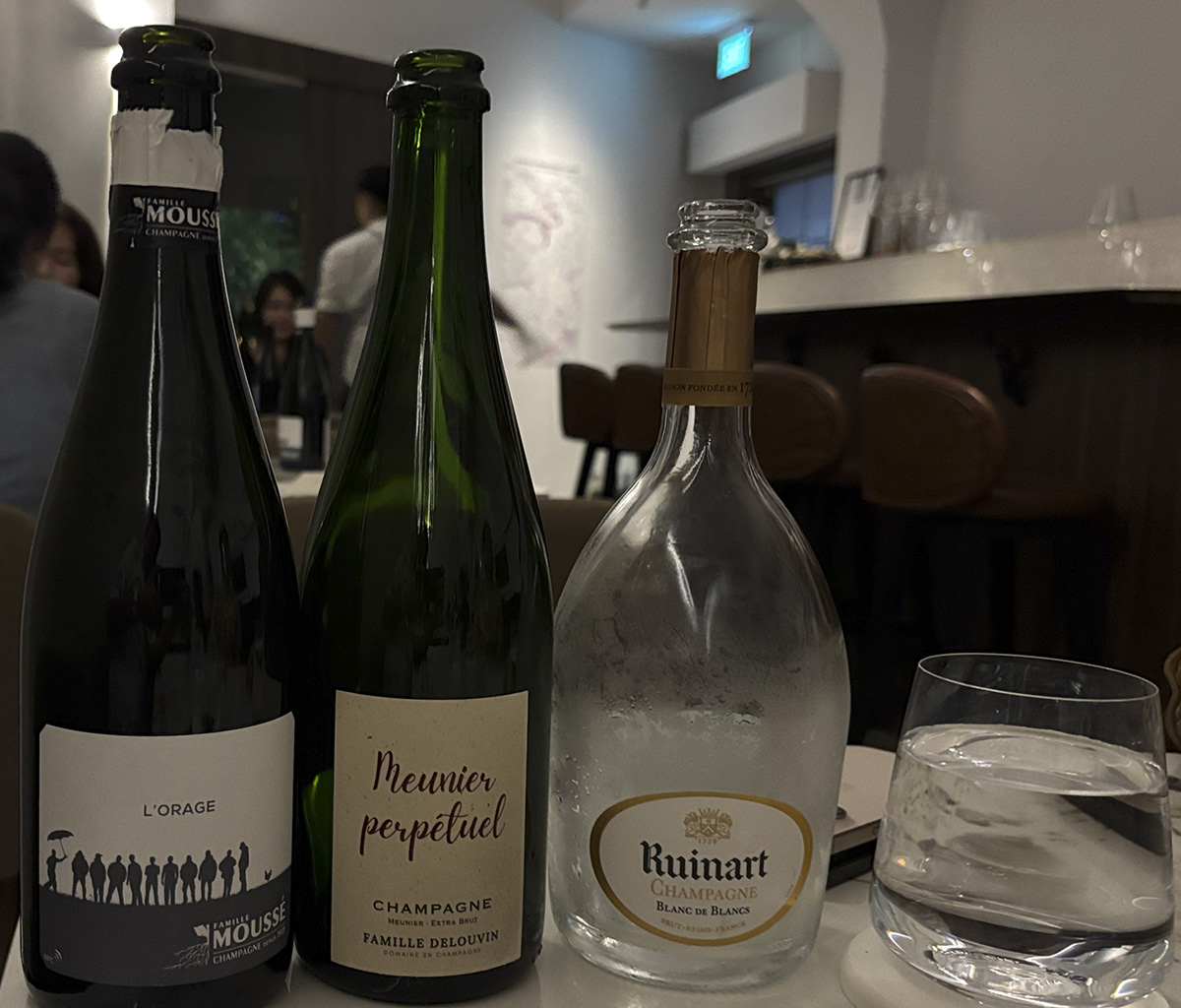
I chose the first bottle.
Familee Moussé L’orage
A favourite house of mine. Especially when Cédric Moussé suffered a fire at the winery earlier this summer. and I wanted to send some moral encouragement. And it came in a bottle with its own story. The bottle is called L’orage, in French meaning The Storm. This is a unique vintage blend, never to be repeated. The 2021 growing season in Champagne was disastrous. The Moussé estate is situated in the Valèe de la Marne village of Cuisles which experienced severe spring frosts, massive storms and violent hailstorm. By harvest time, Cédric had lost 85% of his crop. Then, the amazing generosity of 11 friendly winemakers stepped in. They sold or gifted premium Chardonnay to help offset his losses. On the bottle, we see 11 figures for the friends who enabled this wine. The back label explicitly lists the names of all 11. What a beautiful story of friendship and camaraderie.

Moussé is typically heavy in Meunier, but the grapes offered by his friends were Chardonnay, thus this cepage is made with blending with his own Chardonnay, making this a Blanc de Blancs. The dosage is very tiny at just 0.5g/L, and the disgorgement was 2025.

In the glass, the 12 different crus (11 friends plus his own) is vinified in stainless steel vats to retain clarity, but with full malolactic fermentation. The character is different from Moussé cuvées. The L’orage is focussed, and mineral driven. The nose was rather light with the usual hints of lemon and citrus carried by a base of brioche. But all subtle. The palate is taut, tart with strong salinity and high acidity providing a sharp framework to the creamy depth, reminiscent mildly of caramel.
Famille Delouvin Meunier Perpetual
The second bottle was recommended by Yang of Convivial. The house is a critically acclaimed 100% Meunier champagne from the Vallée de la Marne. The wine is made by Geoffrey Delouvin, the 11th generation winemaker and owner. The base is a perpetual reserve which started in 1992.

This cepage is Meunier from multiple plots of the village of Vandières. The cuvée is 50% new vintage with the other half drawn from the solera system. Vinification of the new vintage is soft pressed and fermentation in stainless steel vats for 70% of the must, and the rest in aged French oak casks. Dosage is kept low at Extra Brut (5g/L).

In the glass, the typical pale lemon with good luminosity shows off the steady stream of bubbles. The nose is rich – creamy baked apples, pears, nuts and pastry. Subtle oxidative notes of honey add to the complexity. On the palate, it is vinous, with piercing acidity cutting through. Finish is clean, but not long with an aftertaste of saline and mineral.
The final bottle of the evening with a bottle of Ruinart Blanc de Blance NV, which I do not need to describe. And as a dessert wine, we decided to do a Ratafi, which both of my friends had not tried.
Chavost Ratafia Champenois
Chavost is another of my favourite RM houses. And we selected this Ratafia by the glass, to round up the meal. Ratafia is a sweet, fortified dessert wine which showcases the natural, low intervention approach of traditional Champagne houses. Usually made from the third pressing, the winemaker introduced neutral grape spirit, usually distilled Champagne Marc or Fine directly to the must in a process known as mutage. This pushes the alcohol to 18.5% ABV, stopping the natural alcoholic fermentation and retaining the deep sweetness of the grape juice.

The Chavost Ratafia Champenois is a blend of 50% Chardonnay and Menuier. A solara system ages the Ratafia in very old French oak barrels. The wine is still, not sparkling. And looks a rich, luminous golden straw in the glass. The nose is a burst of yellow apples, figs, apricot and honey with some spices. On the palate, it is very velvety and very sweet with a syrupy mouthfeel. The high acid of the Champagne grapes is fresher and more balance than Sauternes. Finish is long with notes of toffee. Very enjoyable, and a perfectly nice alternative to Chateau Y’quem, though lacking the layering and complexity of the Bordeaux dessert wine. And the high pricing of the Sauternes.

Henriot Brut Souverain
The Brut .souverain is the foundation flagship cuvée of Maison Henroit. This bottle has a cepage of 50% Pinot Noir, 41% Chardonnay and the rest Meunier. The Chardonnay is primarily sourded from the grand crus of Côte de Blancs and Pinot Noir from Montagne de Reims. The blend is an high proportion of reserve wines of 49% reserve wines, and the rest from the 2021 harvest. Dosage is 2.6g/L, and the champagne sits sur lees for about 4 years.

This is a big house champagne from Reims. The pour looks clear, brilliant straw colour with dense, persistent mousse. On the nose, it opens with citrus, but gradually shifts to pastry due to the years sur lees. A chalky undertone remains throughout. On the palate, it is rather straightforward. Round, harmonious. Acid is mid to high. Once again, big house, mid Champagne.
Concluding thoughts
Thus was August. With some highlights. Champagnes with stories to tell. And I throughly enjoyed all of them. What did you drink of note in August?


