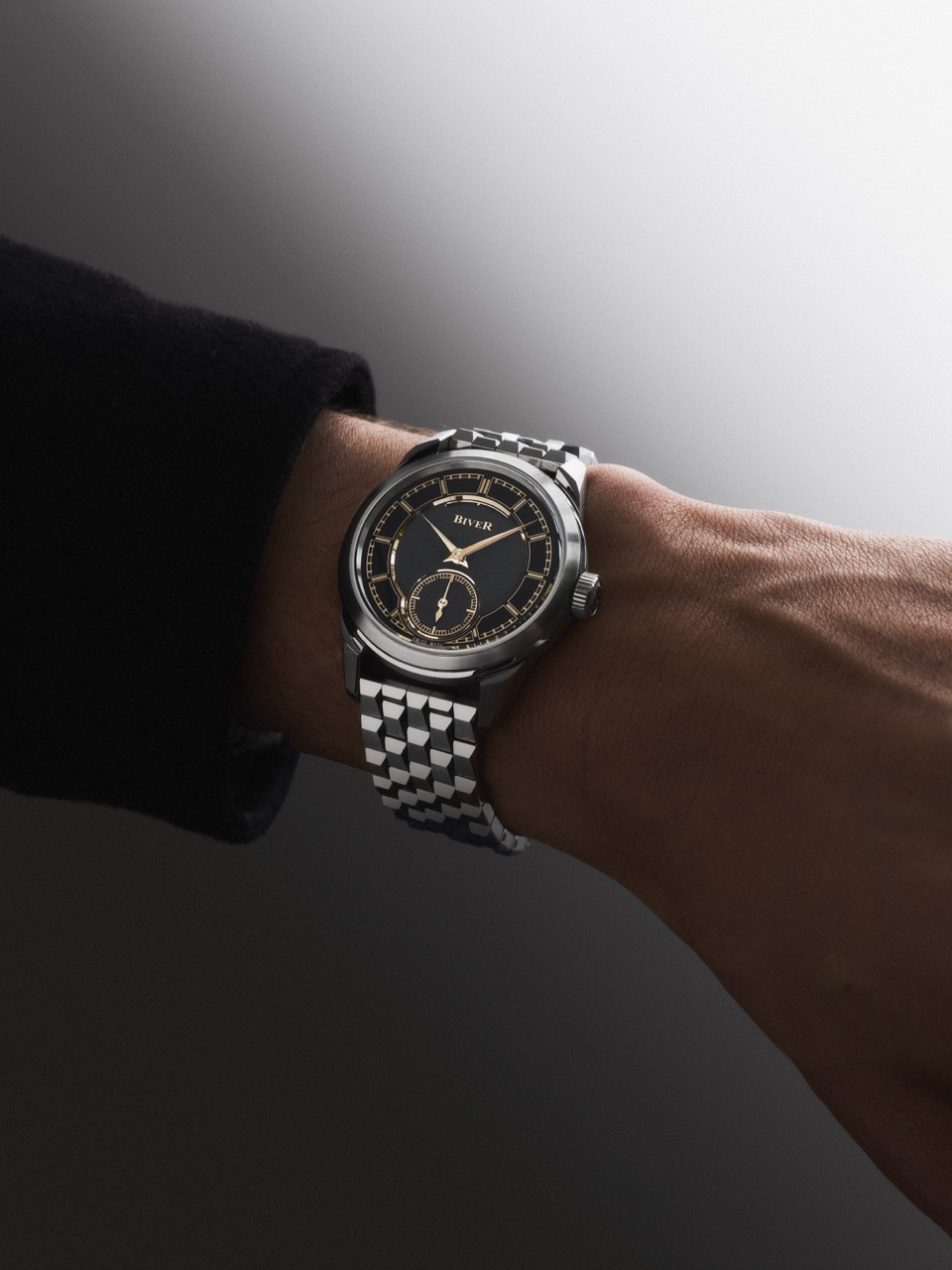
For the first time in its short history, Biver releases a three hand watch in stainless steel with a steel bracelet. The idea of the steel watch came from collectors who backed Biver from the beginning. And now realised in a 38mm case, featuring a brand new hand wound caliber. The dial utilises a new dial technique which blends yellow gold with black DLC and black Onyx for a stunning, high contrast look
Our insider commentary in italics with full release information. The embargo for the release was lifted on October 16.
Biver goes stainless steel with the new AB
Commentary, Price, Specifications & Official Press Release
The Biver AB has a retail price of CHF 68,000 / SGD 119,000. Prices are before Swiss VAT but inclusive of Singapore GST.

Deployant’s Commentary & Analysis
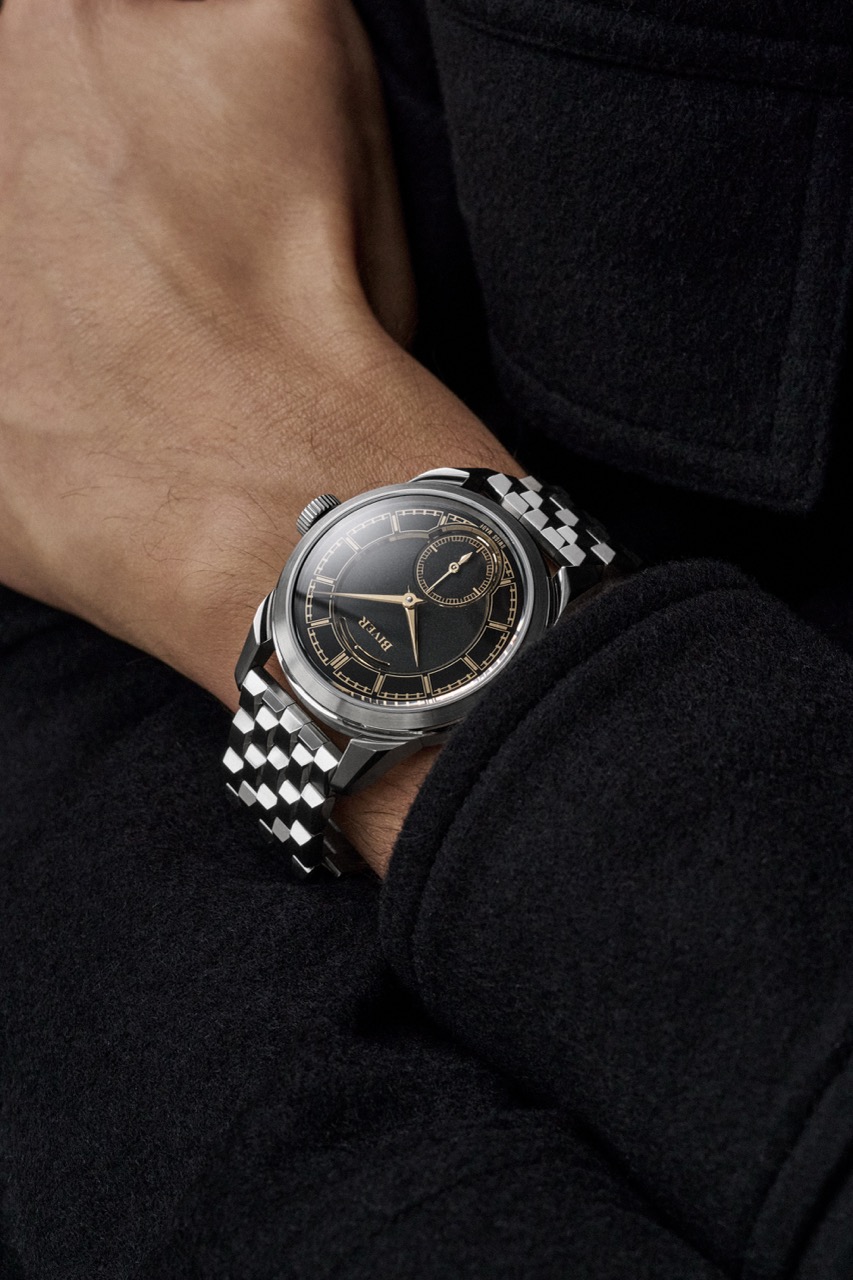
At first glance, the watch looks spectacular! The dial is stunning. Made in yellow gold with the center portion blackened with DLC treatment with a polished, with applied gold (using a metallisation technique) for the chamfered edges, the minute track and hour markers over a high polish black onyx. The visual contrast of the yellow gold elements with the black is beautiful. The Dauphine hands are in yellow gold and hand beveled.

The size is also a great plus factor. This is the effect of JCB’s vast experience in listening to the customers, and making watches which are desired by the market place. The 38mm case diameter with a thickness of just 9.8mm is just perfect for today’s demanding clients. The lug width of 19mm also suggest a highly wearable watch.

The surfaces on the case feature multiple angles with contrastingly finnissage of brushed surfaces juxtaposition with high plished ones. These give the watch a dimensionality and a natural understated beauty. And the icing on the cake is perhaps the small gold pin running on its arc below 12 o’clock which serves as the power reserve indicator. The bracelets continue this narrative. The bracelet is 5 linked, each double faceted, with contrasting finishing applied. This bracelet is looks the same as the other bracelets offered by Biver, except that it is now in steel. It looks to be quite flexible, and having tried the gold version, I can say it is quite comfortable to wear as it wraps around the wrist.
The movement looks spectacular! The main plate and bridges are in a white gold alloy, which Biver calls PD210. Twin barrels give the movement 120 hours of autonomy.

The appearance in the photographs look dark on the surfaces which have been sand blasted, but is highlighted (literally!) by the polished surfaces. The transmission gear for the manual winding mechanism engaging with the teeth of the barrel has a finish contrast which is mesmerising. The barrel drives the power reserve wheel, which features an intricate curved arms. This wheel showcases several inward angles and chamfering techniques.

There is no denying that this is a very beautiful watch. The proportions and surface shapes are well chosen. The aesthetics follow a classical form.
Pricing notes
This is currently the most accessible Biver watch in the catalog, The next up is their Automatique, which is only in precious metal retailing at CHF 73k in rose gold. The 68k retail price for the AB is only about 5k less. Here we are comparing a manual wind watch in steel with an automatic watch in rose gold. Of course the steel AB comes with matching stainless steel bracelet while the automatique has a leather strap. Which is more accessible? Six of one and half a dozen of the other.
At this price point, there are many other small independent makers. For me, I would make the list in three categories. The independent who are a établissement, those who are not artisanal creators but make the watches and movements in-house and the Horloger-Créateur.
In the first category, I would include houses like Hermès, who designs in-house, but sources the technical and component design and movement manufacture to Chronode. A time only steel cased watch with steel bracelet is the CUT (CHF 6k). These are the établissement brands. Then there are those who are not artisans themselves, but design, construct and manufacture all the major components in-house. These will be brands like Czapek, as an example the Promenade Transparencies Aqua Blue (CHF 28.8k), or Gerald Charles with their Masterlink (CHF 24k), or the Moser Streamliner Perpetual Moon Concept (CHF 35k). And finally the Horloger-Créateur, with the likes of Sylvian Pinaud’s Origine (CHF 64k), Raul Pages’s RP2 (CHF 89k) and Luca Soprana (CHF 83k).
The Biver AB sits in all three camps. It is a operated as an établissement (partnering with specialized Swiss movement and component specialists like Cercle des Horlogers and Dubois Dépraz) while maintaining in-house assembly, decoration, and finishing. The Biver name is on the dial, representing both Jean-Claude and Pierre, but neither are watchmakers. The pricing is pitched closer to the level of the artisanal Horloger-Créateur than the others. One can argue that this is because of JCB and his experience in the market, he is able to achieve levels of finishing worthy of the watches worked on by the master watchmaker himself. But one can argue otherwise as well.
Biver AB Specifications
| REFERENCE | AB |
| FUNCTIONS | * Hours, Minutes, Seconds * Manual-Wind, Double Barrel, Zero-Reset Mechanism, power reserve indicated on the dial via golden pin |
| MOVEMENT | * Calibre: JCB-004 * Diameter: 29.6mm * Thickness: 4.6mm * Frequency: 3 Hz (21,600 vph) * Winding: Manual * Power Reserve: ± 120 hours * Jewels: 32 * Every surface is hand decorated to the highest standards. |
| CASE | * Material: Steel * Diameter: 38mm * Thickness: 9.8mm * Lug Width: 19mm * Sapphire crystal with inner anti-reflective coating * Display caseback with sapphire crystal * Water Resistance: 80 meters / 260 feet (8 ATM) |
| DIAL | * Yellow gold (2N) with black DLC, Onyx outer ring * Minutes track in 18k yellow gold 2N, applied using metallisation technique * Hands: 18k yellow gold, satin-finished and hand-beveled with four interior angles * Small seconds at six o’clock: Hand and track in 18k yellow gold 2N |
| STRAP / BRACELET | Delivered on a steel Biver bracelet, with an additional Bahia Calf leather strap and steel buckle. |
| WARRANTY | 4 years |
The Official Press Release
M ADE UNDER PRESSURE
This watch was not our idea. It was our collectors. It came from the people who backed Biver from the beginning. The people who visit our family atelier in Givrins, talk movements with Pierre and Jean-Claude, and stay late to barbecue with the team.
It started as a challenge – to create a Biver watch in steel – and turned into an odyssey that tested our skills as watchmakers and our collective love of horology (and one another). A new material, a new movement, back-up dials, and many sleepless nights later (especially for Pierre, whose second child was born in the middle of this journey). Now, with all of that in the rearview mirror, this watch we once feared has become one of our greatest sources of pride.
The Biver AB is made of steel, and is 38mm in size, and 9.8mm thick. It utilizes a completely new dial technique, and inside is a brand new hand-wound calibre, the JCB-004. This movement continues to test past a 120 hours of power reserve and is hand finished to the same standard as every Biver watch. It is our first steel watch and our first manual-wind watch. It is priced at CHF 68,000 excluding taxes and duties.
“If you know Biver, you know steel isn’t where we’ve spent the last few years,” says Pierre Biver, Co-founder & CEO. “But if you really know Biver, you know we don’t walk away from a challenge. The easy thing would have been to take the Automatique and make it in steel. But my father has always said every watch needs its own soul, and I want every watch to earn its place. So we tore it up and started from a blank sheet, with a new movement, new case, and new dial techniques. It’s the slowest, hardest way to answer a simple request – but it’s the only way we know.”
INSIDE THE AB
The AB is a watch of firsts. It’s our first steel model and our first manual-wind, and at 38mm it’s the smallest we’ve made, too. It is also the first time we’re using 2N yellow gold, which has a fantastic champagne color. On paper, it should have been our simplest watch: hours, minutes, seconds, and an arc at 12 o’clock that shows how much power you have left with a golden pin. But making it was another story altogether. The movement was built from scratch, with two barrels and over one hundred and twenty hours on a single wind. The dial is made of 2N yellow gold and onyx, with a 2N gold track laid directly onto the stone. Everything is hand finished to the same high standard as our Carillon Tourbillon and Automatique, with finishing choice carefully chosen and agonized over. All of this then goes into a steel case designed to take a beating. It’s a bit of a paradox: finishing most people would lock in a safe, in a watch we want you to wear everywhere.
W H E R E TO H I D E
With a watch like this, the details are everything. The small seconds at six o’clock has our signature zero-reset (which we introduced in the Automatique). You just pull the crown and the hand snaps back to zero, allowing for extremely precise setting.
The mainplate and bridges are made of PD210, a special white gold alloy rich in palladium that never tarnishes and doesn’t need plating. “There is nowhere to hide with PD210,” says François Perez, Biver’s Technical Director. “Whatever the hand does is what you see through the caseback.” Each component goes through its own sequence of finishes that must be done in a specific order to yield the desired result. The mainplate alone receives multiple sizes of circular graining and two full days to finish.
For the AB, we’ve introduced sandblasting as a finish for the movement’s bridges, which brought its own set of challenges. The surface is extremely fragile once completed, so every component has to be handled differently from that point on.
It took months of trial and error from our Head Decorator Khaled to find the right grain and the techniques needed to achieve it.
THE PEOPLE BEHIND THE AB
Every AB is built from start to finish by one watchmaker. There are no hand-offs, no assembly line. But behind each watchmaker is a bigger team that makes each watch possible. There are engineers in our Bureau Technique, a team of decorators, quality controllers, and logistics experts. Everyone played a part in the AB’s creation.
They argued, they got things wrong, and they kept going until they got it right.