When I first introduced the Strehler Säntis Worldtimer in March 2026, I had already known Andreas Strehler for more than two decades. This longstanding relationship with the independent Swiss watchmaker gave me considerable insight into his approach to horology, his technical ingenuity and his uncompromising attitude towards manufacture. At that time, however, my assessment was based on my knowledge of Andreas, his earlier works and information available at launch, rather than on the watch itself. I have since had the opportunity to handle the Säntis Worldtimer. In this hands-on review, I examine the watch itself. Its design propositions, dial execution, finishing, movement architecture and the ergonomics on the wrist.
Hands-on Review: Strehler Säntis Worldtimer
The Strehler Säntis Worldtimer has a base retail of CHF 24,750 before taxes. Some customisation is possible. Contact Gabriel Barreau, COO of Strehler for more information.

I made my commentary when the watch was released in March 2026, where I covered:
- Background of the Strehler brand.
- Andreas’ manufacturing philosophy.
- The titanium dial and laser engraving.
- The in-house SA-30W movement.
- The Cottier-style worldtime complication.
- Technical Specifications and pricing.
Please refer to that article for these details. I think it is worthwhile to return to this article and understand the biggest difference between the Strehler branding vis a vis Andreas Strehler and how it compares to other independent watchmakers’ secondary, more commercial brand.
In this review, I will be offering my critique on the case, dial, hands, finishing, the movement architecture, use of the worldtimer operation and how the watch feels on the wrist.
The Case, Titanium Dial and Hands
The case is a very classical case, made in-house at the Strehler facilities in Sirnach, Switzerland. The case is a three-part construction in stainless steel. The case measures a “right sized” 40mm diameter with a 9.7mm thickness and a lug-to-lug measurement of 47mm. The case is similar to the one used in the Sirna time only watch. The case pays homage to Andreas Strehler’s complex Cocon watch case used in his bespoke line, like the Trans-axial Remontoir Tourbillon.

The case is a three piece construction with lugs which curve gently towards the wrist. Andreas designed it this way for the watch to fit large and smaller wrists.

The marvel is the dial. Again, I went into some detail on how the guilloché is made by laser engraving in Andreas’ atelier in the introduction article. But in brief, the pattern is a design by Eric Giroud, and is made by using a low power laser to ablate the titanium dial. This pattern is three-dimensional and a derivative of the design for the time only Sirna. Very low power is used to prevent the laser from melting the dial, causing the pattern to be fuzzy. And because each pass of the layer only removes a very thin layer of metal, the process is repeated many times over more than 15 hours. The pattern engraved is thus very crisp and clear, with clean lines and edges.
The cities and 24 hour rings, both in brass, are machined separately, being finished in circular graining. Both are treated with ruthenium anthracite. The 24 hour ring receives a darker galvanic finish on one half of its surface to show the day/night hours.
Here is where Strehler can offer customisation. The main center medallion, with the engraved pattern can be anodised to a selection of 20 colours.

The hands are also designed and manufactured in-house. The steel hands are made from scratch, with recesses to receive luminous material. This is an important practical detail useful for a worldtimer, as when traversing the globe, one may need to know the time in a dark airplane, or elsewhere where lighting may not be optimal.

The operation of the worldtimer is a Cottier style design. Operation is typical of the Cottier design, which is also used in Patek Philippe World Time Ref. 5231G. The core functionality of the Cottier system utilizes a synchronized, counter-clockwise rotating 24-hour ring paired with an outer 24-city ring representing the global time zones. This layout allows the wearer to read the exact time in all 24 time zones simultaneously at a single glance. Operation of the world timer is detailed at the Strehler Owner’s Manual, accessible here.
The Movement: Strehler Calibre SA-30W
The movement is based on the SA-30 movement which was used in the Sirna. The SA-30 has been time tested and proven to be a reliable automatic calibre. The design is entirely by Andreas Strehler and manufactured completely in the Sirnach atelier.

The movement is designed to be robust and for ease of maintenance. The automatic movement is thin, without any pretensions or any desire to be ultra-thin. None of the components are generically sourced, but are shared between the SA-30 and SA-30W to reduce machining costs. The worldtimer module is also completely developed by Andreas and adds 41 more components to the base movement.
Finishing is very good, especially at this pricing level. It carries not only the finishing appropriate to classical Swiss watchmaking traditions, but also at the level associated with independent watchmakers. Circular Geneva stripes, perlage, bevelling and polished edges are all performed to a very high level of craftsmanship.
Wearing the Strehler Säntis Worldtimer
The dimensions chosen by Andreas are perfect in the current environment. The 40mm case wears well. The curved lugs hug the wrist, and the watch head sits nicely. On my 180mm flat wrists, it feels particularly comfortable.
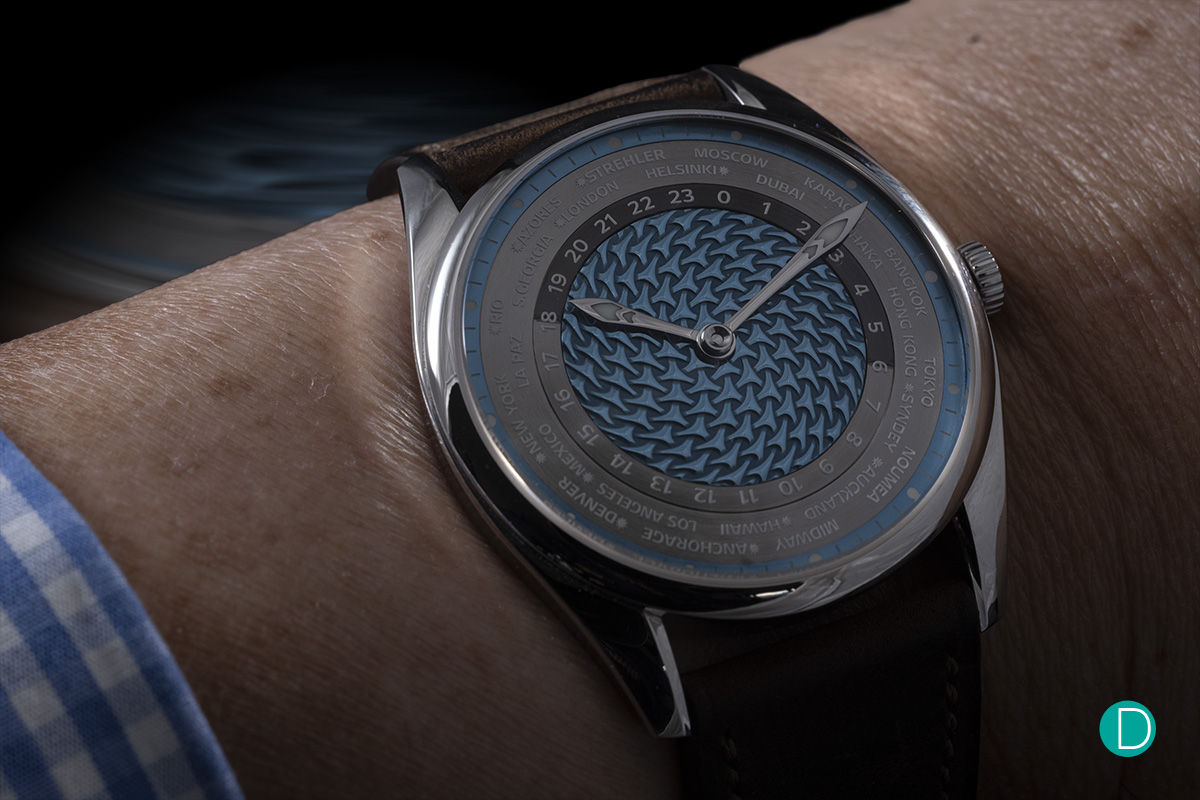
The case height of 9.7mm also means that it can sit under the cuff of a dress shirt easily. And as the case is in stainless steel, it is well balanced and the watch head stays between the wrist bones properly.
The worldtimer operation is intuitive to use. Once set properly to local time, the time of any of the cities marked on the dial can be easily be read. All adjustments are manipulated by the single crown, and Andreas has designed in security features to ensure that it can be operated safely.
Pricing considerations
At a base retail of CHF 24,750 before taxes, the Säntis occupies an interesting position in the worldtimer category. It offers an in-house developed and manufactured movement, and unusually sophisticated titanium dial and the opportunity for personalisation, while retaining the design restraint and technical thinking that characterise Andreas Strehler’s work. The ability to personalise the dial is something rarely encountered in a more commercially structured collection.
Concluding thoughts: an Independent Worldtimer by Andreas Strehler
The Säntis Worldtimer is an interesting proposition in independent watchmaking. It represents the second offering from Strehler, Andreas Strehler’s more accessible brand. This second brand is not simply a commercially produced watch carrying his name. The watches bearing the Strehler name feature design, movement development and manufacture completely within Andreas’ facilities in Sirnach.
This is an important distinction. The main Andreas Strehler brand remains the place for fully bespoke creations, where Andreas personally attends to individual collector requirements, including requests for special complications. Strehler, on the other hand, applies the atelier’s accumulated expertise and manufacturing capabilities to a more structured collection, allowing the benefits of a more industrialised approach to be passed to the customer.
Yet the Säntis is not without its own personalisation possibilities. Andreas tells me that the dial colours offer considerable freedom of choice. Since the original launch, Andreas is also open to other possibilities. One of which is the possibility of changing the city names on the worldtimer. This is an additional cost option. If you are interested, you can discuss this with Strehler. In our discussion, we explored replacing Hong Kong with Singapore. This could be an interesting possibility for a collector who wants a more personal connection to the watch.
For me, the most compelling aspect is that the Strehler name does not represent a compromise in authorship or manufacture. It is a different way of delivering Andreas’ watchmaking, and the Säntis is a convincing expression of that ambition.
Strehler Säntis Worldtimer Specifications
| Movement | Manufactured in-house * Calibre SA-30W Automatic mechanical movement * Dimensions 30 mm * Height 5,05mm * Parts 224 * Jewels 30 * Power Reserve min 60 hours * Escapement Strehler Swiss Lever escapement with free sprung balance using 4 regulating screws * 21,600 bph * Functions Hours, minutes and world time with day-night indication * Rotor 18k gold with ceramic ball-bearing * Decoration Circular Geneva stripes, perlage, polished bevelled edgesw ith inward angles |
| Functions | Hours, minutes, Seconds, Worldtime |
| Case | Manufactured in-house * Material: Medical grade stainless steel * Diameter 40mm (47mm lug to lug) * Height 9.7mm * Crystal Anti reflective sapphire * Back secured by 4 screws with sapphire crystal * Water resistance of 30m. |
| Dial & Hands | Manufactured in-house Titanium, machined, laser engraved, polished by hand and anodised – Proprietary pattern derived from a design by Eric Giroud – Circular-brushed stainless steel chapter ring – galvanized brass 24-hour ring with day-night indication – Anodized titanium minute track ring with luminous dots Hands Hand-polished faceted stainless steel tipped with white * SuperLuminova C1 BL X1 with blue luminescence |
| Strap | Manufactured by Ledertique and Atelier Petrov * Material Brown calf leather with off-white stitching * Size 22mm x 18mm |
| Buckle | Manufactured in-house * Material Medical-grade stainless steel |
Strehler Säntis Worldtimer FAQ – what you need to know
Yes, the Strehler brand is the secondary brand by Andreas Strehler to make his creations more accessible to the public. Unlike the bespoke watches of the main brand, the Strehler watches lean on industrialisation expertise of the atelier to provide economies of scale. But like the main brand, it retains full design and manufacture in the Strehler facilities in Sirnach, Switzerland. Unlike many other independent makers’ secondary brand who use third party movements, or use contract manufacturers, all the work is performed within the Strehler facilities.
The retail for the base Säntis Worldtimer is CHF 24,750.
Yes, some customisation is possible. For the standard offering, there are 20 options to customise the colours on the dial. Further customisation is possible, but it is best to contact Strehler to discuss your needs.
The Säntis Worldtimer is based on a design by Louis Cottier. It works by combining a standard central time display to two synchronised rotating rings. One outer ring is marked with names of cities and rotates clockwise. An inner ring carries 24 hour markings and moves counter clockwise. To set the watch, the outer ring is aligned to city representing the local time to the 12 o’clock position, and sets the central hands to the correct local time using the 24 hour disc to establish whether it is day or night. Once this is set, the local time in any city marked on the ring can be read by corresponding the hour off the 24 hour ring.