Reuben Makes his GWD26 Armchair Picks
Being asked to do Armchair Picks from the exciting releases from Geneva Watch Days 2026 feels, in spirit, very similar to creating a fantasy Formula 1 team roster. A key difference, however, is that I have a significantly higher chance of holding (and mayhap one day owning) these pieces than being team principal at Ferrari. With that, let’s take a look at which pieces caught my eye and snagged my heart!
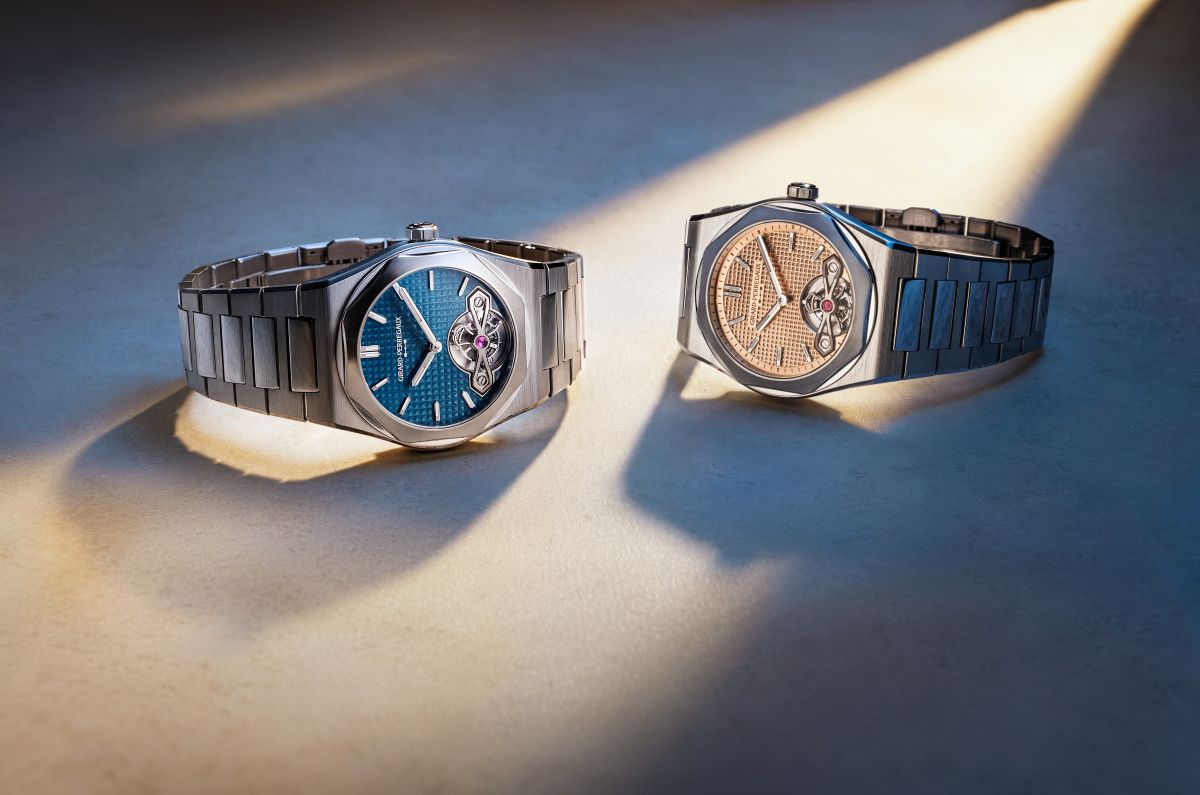
Girard-Perregaux Laureato Fifty Tourbillon Micro-Rotor 39mm

The Girard-Perregaux Laureato Fifty Tourbillon Micro-Rotor 39mm is quite the mouthful for what remains a very familiar watch. Last year’s Laureato Fifty reworked the case and bracelet to incredible levels of refined execution, while keeping the octagonal architecture intact. For 2026, Girard-Perregaux subsequently expanded the collection with a blue Grand Feu enamel dial and a solid-gold dial in a rose-gold tone. Now, the latest Laureato adds a tourbillon, a platinum and pink-gold micro-rotor and an entirely new calibre, the GP8410, all sitting within a very wearable 39mm case measuring just 10mm thick.

What interests me more is the direction of travel that Girard-Perregaux has undertaken. Rather than constantly reinventing the Laureato, Girard-Perregaux seems to be slowly layering horological complexity onto what is already a solid foundation. The new GP8410 places a micro-rotor neatly into the movement architecture, leaving the reverse unusually open, with large white-gold bridges and plenty of visual breathing room around the tourbillon. Frankly, the whole layout is screaming to be skeletonised at some point. If the Laureato Fifty is now the platform, this feels less like the finished product and more like Girard-Perregaux showing us how far it intends to take it.
MING 57.05 Comet

I have generally judged watches through some combination of history, intent and design. MING is only about a decade old, so history is perhaps pushing it, but intent and design are certainly present. Its usual design language has been built around radial symmetry, circular motifs, flared lugs and layered sapphire elements, which makes the MING 57.05 Comet’s more architectural, overtly Art Deco treatment rather striking by comparison. The Comet is a world timer with a genuinely clever trick: its system allows the wearer to compensate for daylight saving time by shifting the relevant cities without upsetting those which do not observe it. It is the sort of idea that seems obvious only after somebody has bothered to do it.
There is also a much less horological reason I like it. MING’s design and engineering are based in Kuala Lumpur. Not Geneva, Le Brassus or some impossibly picturesque corner of the Vallée de Joux. Kuala Lumpur, right here in Southeast Asia. For a young independent brand doing its design and engineering in this part of the world to produce something that is not just visually distinctive but actually attempts to improve a century-old complication is rather compelling. Provenance matters in watchmaking, but it does not always have to mean Switzerland.
L’Epée 1839 The Football

My final pick is not a watch. It is a football that tells the time. Honestly, what more could you reasonably ask of it? L’Epée’s The Football is a full-scale 220mm mechanical sculpture weighing 4.2kg and comprising 882 components, with an in-house movement beating at a leisurely 2.5Hz and offering eight days of power reserve. Hours and minutes are displayed on rotating discs through two of the hexagonal apertures, while the openworked structure leaves much of the movement on show. Because apparently your football also needs an eight-day power reserve.
There is plenty of method to the madness. L’Epée has increasingly moved beyond the traditional idea of the table clock, instead treating these objects as kinetic sculptures where the movement becomes part of the thing being depicted. Cars, robots and all manner of mechanical oddities have received the treatment; The Football simply takes that philosophy to its wonderfully literal conclusion. Its pentagons and hexagons are not merely wrapped around a clock movement but form the architecture through which the mechanics and time display are experienced. Would I kick it? At 4.2kg, probably not. Do I want one sitting in my house while I explain to increasingly bewildered guests that, yes, the football is in fact a clock? Absolutely. It is a football that tells the time. You literally cannot ask more of it.