
We visited the legendary champagne house of Billecart-Salmon. The village of Mareuil-sur-Aÿ, just outside Épernay, the maison occupies an interesting position in the Champagne landscape. Founded in 1818, and still family-owned, it is larger than the small grower producers, yet retains a distinctly family-led approach to its wines. During our September visit, we tourrd the family estate, saw the Clos Saint-Hilaire monopole and followed the winemaking process from the cuverie to the chalk cellars. We also tasted three of the maison’s champagnes, gaining a closer understanding of the house style built around freshness, finesse and precision.
Our visit was courtesy of Billecart-Salmon, and we joined a group of enthusiasts who signed up on the Billecart-Salmon website.
Inside Maison Billecart-Salmon: Discovering the Champagne House in Mareuil-sur-Aÿ
The Maison Billecart-Salmon champagnes are labelled as Negociant Manipulant, and are made from their own estates (about 100 hectares) and they also source grapes from an wider area totalling 300 hectares across 40 crus in the Champagne region.

The majority of the grapes used for vinitication are from a radius of 20km of Epernay, planted with grapes from the Grand Crus of Pinot Noir, Meunier and Chardonnay in vineyards in Montagne de Reims, the Valée de la Marne and Côte des Blancs.
Maison Billecart-Salmon: A Family Champagne House since 1818
The house is still family owned till today, now in the 7th generation of the Roland-Billecart family. The maison was established in 1818, when Nicolas François Billecart married Elisabeth Salmon. The house was estalished alongside Louis Salmon, Elisabeth’s brother. In 1958, the fifth generation owner, Jean Roland-Billecart modernised winemaking by pioneering cold-settling and low temperature fermentations. The sixth generation was then run by Jean’s two sons – François and Antoine Roland-Billecart. They positioned the brand away from mass market, and expanded globally. The current CEO/President is Mathieu Roland-Billecart is the second cousin of François and Antoine. He works closely with his great-uncle Jean, together with François, and Antoine.

Together, the three generations of the Roland-Billecart family work together, serving in the Tasting Committee. This committee is the literal guardian of the house’s style. Rather than relying on a single chef de cave (cellar master), the eight person committee presides over how the wines are released. The committee comprise of the four family members and four non-family members. The former being the 5th generation patriarch (Jean), 6th generation leaders (François and Antoine), and the 7th generation CEO (Mathieu). The non-family members are the key technical staff like Florent Nys (Chef de Cave) and Denis Blèe (Directeur Vignoble et Vins), François Domi (former Chef de Cave who spent 30 years leading the house), and Guillaume Berbe (a key member of the estate’s internal oenological and technical team)
The Billecart-Salmon Estate in Mareuil-sur-Aý
The family estate is a beautiful property in the village of Mareuil-sur-Aŷ. This property houses the main offices as well as the residences of the Roland-Billecart family. The village is located in the Valée de la Marne, near to both Epernay and Reims. It carries vineyards as Premier Cru, and for exceptional Pinot Noir. The village is part of the UNESCO Champagne Hillisides, Houses and Cellars World Heritage site.

The house features a meticulously kept French-style garden. At its center stands the majestic 100 year old horse chestnut tree which has watched over all seven generations of the family. The family keeps the production tightly bound to the village.
Clos Saint-Hilaire: Billecart-Salmon’s Prestigious monopole
Their most prestigious single plot vineyard, the Clos Saint-Hilaire is located right across this main house. This plot is the ultimate crown jewel in Champagne Billecart-Salmon. The plot is exactly one hectare, and entirely enclosed by walls (hence clos). It is planted with 100% Pinot Noir in 1964, The house makes the magnificent Blanc de Noirs designated as “Le Clos Saint-Hilaire”, a prestige monopole champagne made entirely from the grapes of this clos.

The plot is managed traditionally. The soil is turned and tended exclusively with workhorses and motorised machinery is banned. Vinification is entirely in small oak casks, and the bottles are aged 13 to 15 years on the lees before release. It is finished as Extra Brut or Brut Nature, with 0 to 2 g/L of dosage. The production is extremely limited and number between 3500 to 5500 bottles per vintage. The inaugural vintage was launched in 1995, and is only produce in years where the grapes are judged to be perfect.
Inside the Billecart-Salmon Cuverie: The Art of Vinification
From the Clos Saint-Hilaire, we moved to the Cuverie, where the winemaking takes place. Freshly pressed grape juice is cleared off sediment, skins and stems. In standard champagne production the juice settles briefly at 15°C. Billecart-Salmon uses a different method. The pressed juice enters the stainless steel tanks and settles at 8°C for about 12 hours. The must is then racked into clean tanks and chilled further to 2°C for another 48 hours. This chill clarifies the must and preserves freshness and delicate aromas.

Standard champagne primary fermentation takes about a week at about 20°C. At Billecart-Salmon, after settling, yeast is added and the must is kept at 13°C. This lower temperature causes slower fermentation, allowing a more delicate fruit character that would normally have evaporated at higher temperatures. The low temperature also preserves the high natural malic acid, creating the acid backbone and structural freshness of the champagnes.
Vinification is carried out cru by cru and by grape variety. This allows for complete control of each batch and the Chef de Cave to conserve the nuances of expression of the terroir. By vinifying at a low temperature, the fermentation is slow, and encourages ethereal aromas.

From there we move to where the wine is aged in oak casks. Each cask is chosen and shaped to reveal the complexity of the wines. Each parcel is individually identified and kept in separate cask. This stage is a rather more traditional approach to winemaking, and when combined with vinification in stainless steel tanks, adds layers of elegance and flavour to the wine.

We also saw some of the large casks used as part of their solera system. The casks below are part of a new experimental technique Billecart-Salmon is developing.

The Chalk Cellars: Ageing and Riddling
We then moved underground to the chalk cellars. Here along kilometres of tunnels dug in the 17th to 19th centuries, the second fermentation takes place. This is where the aromas develop. The finesse, balance and elegance is expressed. This also where the bubbles are formed and are integrated into the wine over a period of 3 to 4 years for the non-vintage champagnes. The vintage cuvées are aged at least twice as long.

In the dark, the character of the champagne develops. When ready, the bottles are turned in a technique called riddling, where the dead yeast (lees) is encouraged to settle to the top of the bottle. The bottles are gently turned, an eight or a quarter rotation, progressively tilting the bottle until the crown cap points straight down.

At Billecart-Salmon, this process is done by an automatic machine called Gyropalettes. About 80% of the production is automated this way to ensure speed and technical consistency. The rest of the champagne are riddled by hand. These are mostly for special formats – unusually shaped bottles or exceptionally large botttles and older vintage and prestige cuvèes that have been aging on the lees for more than 10 years.

From here, the bottles are disgorged once determined to be ready by the Chef de Caves. Disgorgement and dosage is applied by machine, ensuring cleanliness and consistency. We did not get to see this process in the tour.
Tasting Billecart-Salmon: Three Expressions of the House Style
We then moved to the tasting room, where three champagnes were prepared. First the Elisabeth Salmon Rosé Milleséme 2013. Then the Louis Salmon Brut Blanc de Blancs Millêsieme 2013, and the Le Blanc de Blancs from their Gallery Collection. In classical tradition, we began the tasting with the cuvée, and progressing to more complex flavours offered by the Louis Salmon and Elisabeth Salmon. (From right to left in the bottles shown below.)
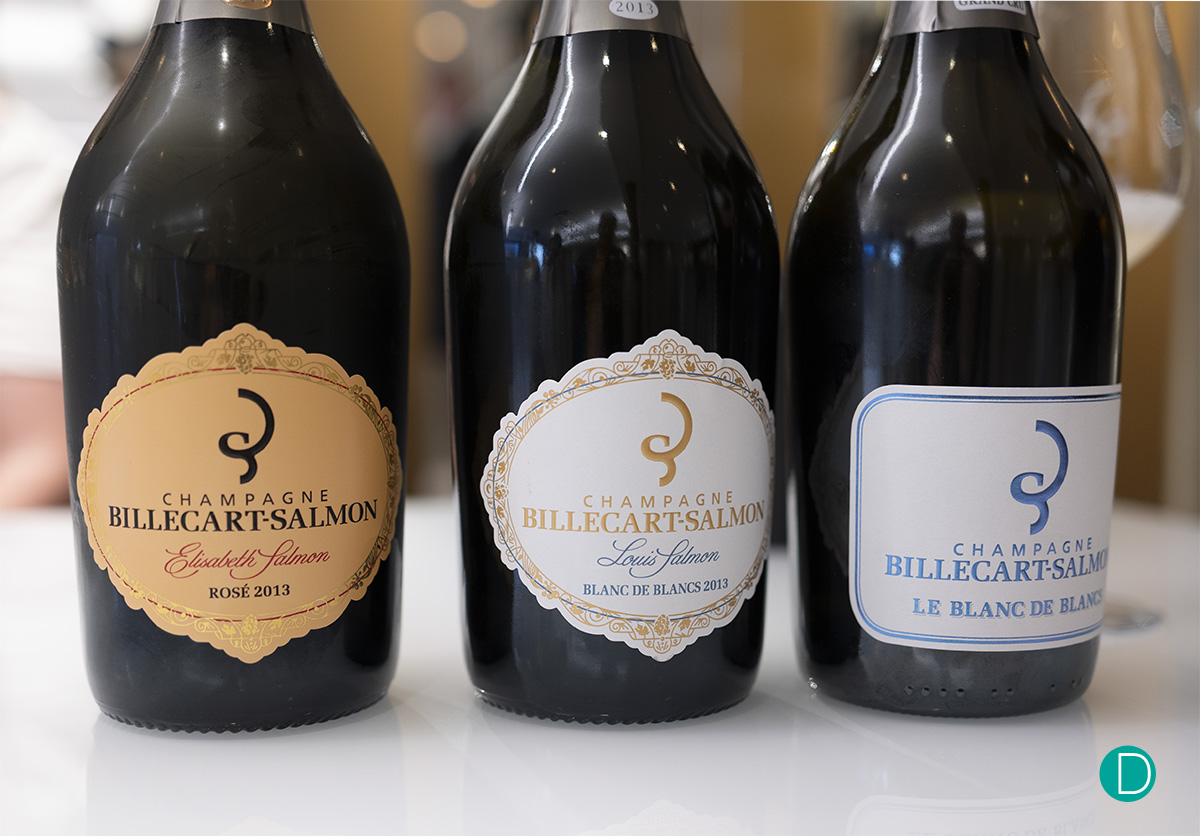
The Blanc de Blancs cuvée is an elaboration from 4 Grand Cru vineyards of Côte des Blancs : Avize, Chouilly, Cramant, Mesnil-sur-Oger. The appearance in the glass, shown far right, is a delicate mousse, with a luscious pale lemon hue. On the nose, it shows a mineral intensity, accompanied by notes of brioche and white flowers. The palate has a chalky texture, with almonds, citrus and lemon notes. Very silky and a delicate finish.

Next up, the Louis Salmon 2013. This is a blanc de blancs. The grapes are from a parcel of the Côte de Blancs and shows up in the glass as the usual pale lemon hue with a distinct gold tint. This is shown in the glass in the middle. The nose had white fruits, apple and pear with the palate revealing a ripe fruits and a crispy and bright salinity. The buttery mouthfeel is also present. Finish is long and elegant.
And finally, we had the Elisabeth Salmon Brut Rosé Milleséme 2013, shown far left in the photograph. The cuvée is 45% Chardonnay, 45% Pinot Noir. 10% of red wine Pinot Noir is added to make the rosé. Vinification is 3% in oak. On the glass, it presents as a salmon peach colour. The nose is pleasant, with strong notes of citrus, fresh fruits and mandarins. On the palate, a salinity expresses itself with delicate flavours of butter and saffron. The structure is delicate with a long finish.
A Lasting Impression of Maison Billecart-Salmon
The visit was an eye opener. This is not a standard champagne house. Those who line the Avenue de Champagnes in Epernay are very large maisons. Those in the villages of Avize et al, are small recoltant manipulants. In the middle sits Billecart-Salmon. A rather large house, but still family owned. And made with family traditions.
In the watchmaking world, this would be like Patek Philippe and Chopard. Independent, family owned houses. The analogy extends to more than just names. Large Champagne houses like Moët & Chandon and Ruinart have scale and extensive sourcing networks. This the analogy to Richemont, Swatch Group amd LVMH brands. Grower-producers, the recoltant manipulants like Familie Mousse and Lavinista are defined by their own vineyards, and weather conditions. These are the Independents: the likes of Rexhep Rexhepi, Sylvian Pinaud and Philippe Dufour. And like Patek and Chopard, Billecart-Salmon combines the substantial scale with family ownership, a strong estate presence and a closely guarded house style.

The methods of making champagne is traditional and classical, though the techniques refined by the house, such as the cold settling and cold fermentation set it apart from the big houses. Many hail Billecart-Salmon as a house with gastronomic ambitions, centered on freshness, finesse, purity of fruit and a beautiful balance. Their champagne has a special place in my heart, and remain one of my favourites.


